It was on a Friday the 13th - March 13, 2020, as the world was shutting down - that the seed for Project Audion sprang to life.
Coronavirus was dragging our daily lives to a halt with alarming suddenness in both large ways and small. One of the small ways involved a theatre troupe in Dallas Texas, which had just opened a radio-style theatrical drama for live audiences. I was part of the cast, and that Friday morning we were told the evening's show would suddenly become our closing night; the performance space had been ordered closed immediately.
Just before the curtain, one cast member balanced an iPhone on a ladder behind the audience and livestreamed the event to Facebook. Afterwards, it turned out more people watched online than braved being part of the live audience. Driving home I started thinking - couldn’t this be done online somehow?
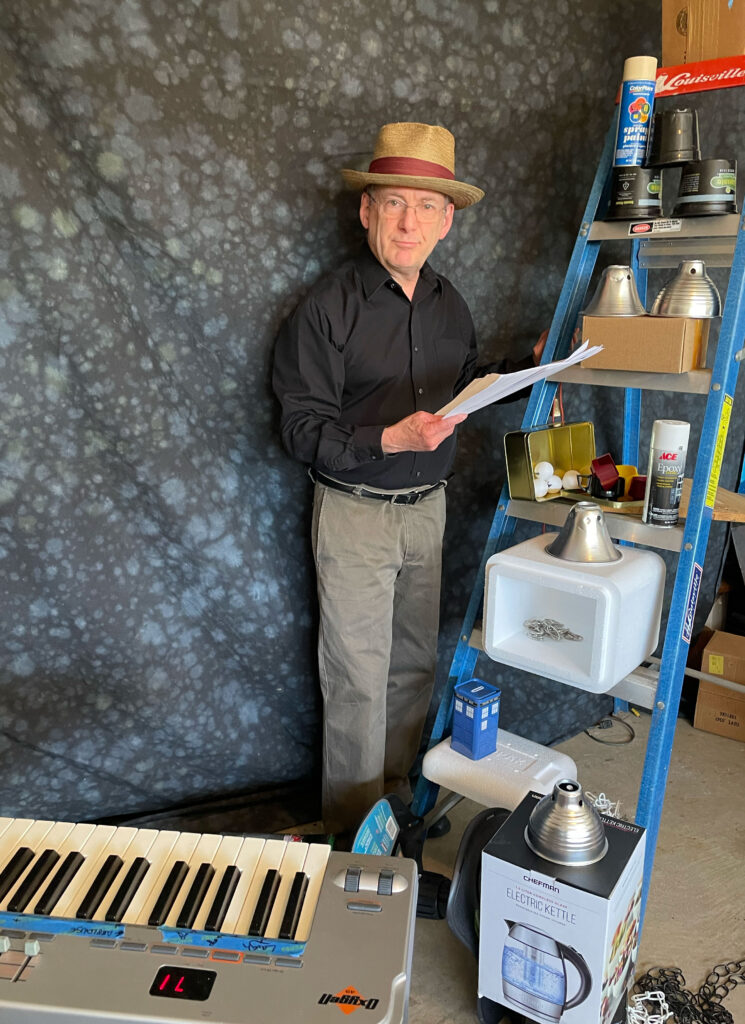
By now I’d been doing radio recreations on and off for four decades, ever since running into a gregarious, eccentric Texan named Bill Bragg who had a vision of starting a museum devoted to broadcasting and an old-time radio network to go with it. That museum has been gone for decades now, but Yesterday USA still goes on, and so does the Generic Radio Workshop, a loose-knit group of radio re-enactors we created. When I launched our genericradio.com website to share some of the scripts we'd collected, I didn't expect nearly 20 years on it would be the most popular online library of shared vintage radio scripts. But because so many folks have contributed scripts to the collection, I've met many terrific people across the country who all shared an enthusiasm for re-creating old time radio magic in communities in Colorado, Kentucky, Florida, Illinois, Texas - even Canada and England.
So during March and April 2020 I reached out to some of these folks. Now all stuck at home, the idea of online radio recreation appealed to everyone. At the start of the pandemic, Zoom was not yet ubiquitous and there were no experts to consult, so we had to muddle through and work out things as we went along. Trying to do a quality live streaming performance soon proved too tricky, so we opted to let Zoom record the performance and then upload it. That had the benefit of enabling me to record a scene-setting introduction, out in a field where a clear channel radio station had once stood. On May 3, 2020, under the name "Project Audion" we premiered our first show - a lost 1946 Suspense episode titled "The Keenest Edge." Zoom's audio was a little rough, the video not terribly special, but it was something old and something new all at once.
And then we dived back in and did it again. For a few months we produced a new show every two weeks. It was the pandemic, after all, and everyone had plenty of time at first. It felt a bit like the Golden Age of network Radio all over again - creating an anthology series with new casts, effects and music for each new episode on tight deadlines.
Unlike most podcasts of modern audio drama, Project Audion shows are guided by the production techniques of 70 years ago. Our voice actors, drawn from different audio drama troupes across the country, meet once to read thru a script, once to rehearse with the sound effects and recorded music, and a final time to record the show in a continuous take. Sound effects are performed live as much as possible. Music comes from a variety of sources, including original recordings. At the end of our collective recording session, we sometimes conclude that a second take might go better and so we reset and do the whole show again ("for the West Coast" as the standing joke goes). Only from that point we do take advantage of the technologies afforded by Zoom, which has recorded separate audio tracks for each participant. Because a variety of mikes and home studios go into the recording, mixing them after the fact together smooths out the audio differences. Post-production also enables us to create a video with visuals lifted well beyond a plain Zoom videoconference -- while still acknowledging that this show was created by actors performing separately yet all together in real time.
As a result, you can listen to a Project Audion show and experience a fully-satisfying vintage radio recreation, or you can watch and eavesdrop on the actors and sound effects as they happen.
Project Audion premieres a new video on the second Friday of every month on YouTube, while audio-only versions are sent to the Mutual Audio Network and Moonlight Audio podcasts. To date, nearly 80 actors spanning eight decades in age have performed, guided by nearly a dozen directors. Nearly a third of the episodes have featured "lost scripts" for which no recording survives, using scripts from the archives of the Generic Radio Workshop and elsewhere. It's especially satisfying to bring a missing "Suspense," "Saint," or "Red Ryder" script back to audible life.
We've also bent the rules a few times with several special episodes newly-written for us by Robert L. Mills. Mr. Mills, now in his mid-eighties though seeming much younger, was one of Bob Hope's staff writers beginning in the 1970s and so is a direct link to the age of classic radio comedy. His comedic chops are still strong, and the "new episodes" of Jack Benny and Charlie McCarthy that he’s penned feel like lost shows. These performances are very much what Project Audion is all about - a celebration of old and new - a classic art form brought to fresh life through new technology - created by a growing group of truly talented folks who are real fans of vintage radio drama, variety, and comedy.
--Larry Groebe
